
HOME / MANUFACTURING & CAPACITY
Manufacturing & capacity
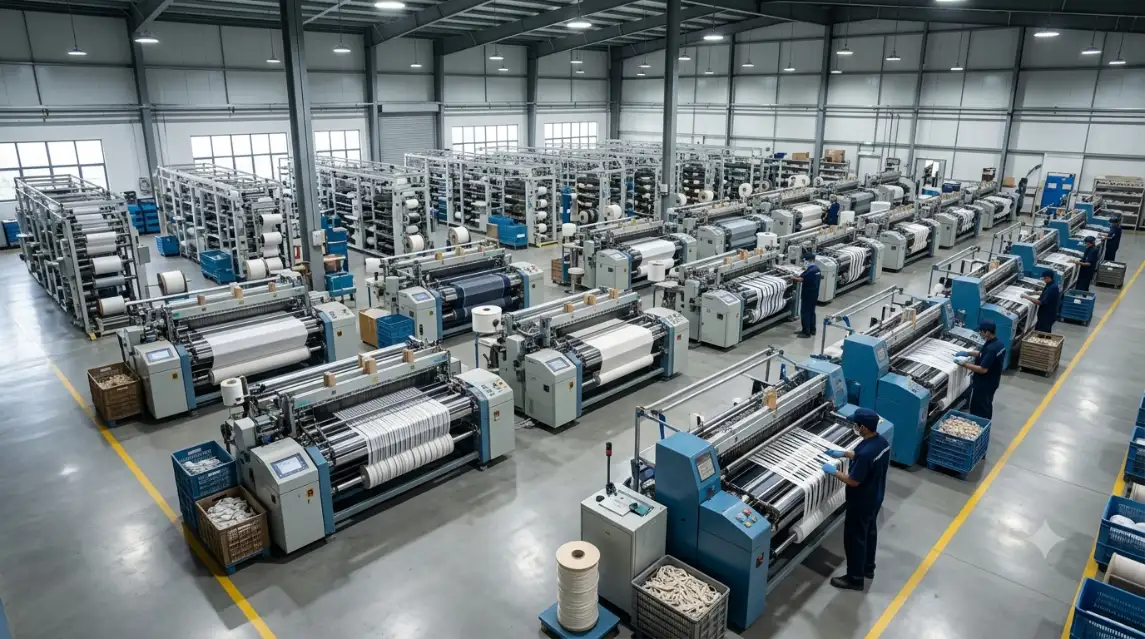
Trims Bangladesh runs a garment trims factory of 18,000 sq ft in Uttarkhan, Uttara, Dhaka — 165 people across 30 office staff and 135 production workers, operating 24 hours shift-wise since 2014.
18,000
sq ft factory area
165
People on site · 30 office, 135 production
24 hrs
Factory operation, shift-wise
2014
Manufacturing since
// ON THE FLOOR
Every stage under one roof
Machinery of Taiwan origin runs each step in-house — so a single order can move between product families without changing supplier, and a repeat order comes off the same machines as the first one.
- Jacquard elastic loomsWoven-in logos and patterns
- Weaving-belt machinesElastic and belt webbing
- Twill tape machinesHerringbone tape
- Winding machinesYarn preparation
- Bobbin windersBobbin feed for the looms
- Wrapping machinesCovered elastic yarn
- Plastic tippingDrawcord and drawstring ends

// WHAT WE CAN RUN
Daily capacity by product
| PRODUCT LINE | DAILY CAPACITY |
|---|---|
| Jacquard elastic | 25,000 yds |
| Woven elastic | 20,000 yds |
| Knit elastic | 50,000 yds |
| Button-hole elastic | Made to spec |
| Herringbone & grosgrain tape | 80,000 yds combined |
| Drawcord & drawstring | 60,000 yds · 3 categories |
| Gum tape | Made to spec |
Quality assurance
Our own in-house lab runs three ISO test methods on every production lot before it is cleared for dispatch — which is what keeps shade and hand-feel consistent across repeat orders.
- pH testISO 3071
- Colour fastness to rubbingISO 105 X12
- Colour fastness to waterISO 105 E01
Certification

STANDARD 100 by OEKO-TEX®, certificate 2022OK1327 — Product Class I, the strictest class, covering baby articles. Valid until 31 May 2027.
See the certificate and scope →// MACHINERY
Inside a garment trims factory: machines, shifts and output
The floor runs on Taiwanese narrow-fabric machinery: winding and wrapping machines, jacquard elastic looms, bobbin winders, twill tape machines, plastic tipping machines and weaving-belt machines. Each of those maps directly onto something a buyer can order. The jacquard looms are what let a logo be woven into a waistband rather than printed onto it. The twill tape machines produce the herringbone and grosgrain that bind and face garments. The plastic tipping machine is why drawcords can arrive cut to length and tipped rather than as bulk cord your line has to finish.
Running 24 hours shift-wise is what makes the lead times on this site the same for every order regardless of size: a physical sample 4 working days from a confirmed spec, bulk 10 days after that sample is approved. A single-shift factory quoting the same figures would be quoting its best case rather than its normal one.
Where a product has a standing set-up we publish its daily figure, and where it does not we say made to spec instead of estimating. Button-hole elastic, gum tape, belts, buttons, thread and the whole label and badge range are quoted against your drawing, because hole pitch, size, colour count and finish change the run enough that a published number would mislead more than it informed.
// WHAT THE NUMBERS MEAN
Reading the capacity table
Two of the figures above are shared rather than per-product, and it is worth being explicit about why. Herringbone and grosgrain tape share a combined 80,000 yards a day because they run on the same twill-tape machinery; drawcord and drawstring share a combined 60,000 across three categories for the same reason. They remain separate SKUs and can be ordered in any mix on one purchase order — the shared figure describes the machinery, not a restriction on what you can buy.
The elastics are the exception, with three individually published figures: knit at 50,000 yards a day, jacquard at 25,000 and woven at 20,000. Those are separate machines, so the numbers are separate. Quality control sits behind all of it — every lot tested in our own lab against pH (ISO 3071), colour fastness to rubbing (ISO 105 X12) and colour fastness to water (ISO 105 E01) before it leaves the building.
The full product profile.
Every product line, capacity figure, lead time and certification in one PDF — the document buyers use for vendor onboarding.